

A 90-Day Plan for a B2 Language Exam
July 14, 20264 min read
A 90-day plan for a language exam with reading, writing, listening and speaking parts: a baseline test, an AI Mentor course, spoken practice and timed mock tests you bring.
Skip to the guideGeneral language learning and exam preparation are different jobs. An exam has a syllabus, a format and marking criteria. It tests specific things in specific ways under time pressure, so practising the format matters as much as your general level.
This path is narrower than a general one. Ninety days, one target: the exam.
Does this apply to your exam? The method works for any language exam with reading, writing, listening and speaking parts: IELTS or TOEFL, Cambridge exams, DELF, DELE, Goethe-Zertifikat, or similar, at the B2 level used as the example here or at another level. pimReader teaches English, German, Spanish, French, Italian, Polish and Portuguese, so the exam must be in one of those. To be plain about the limits: pimReader includes no official exam papers or mark schemes. You bring the practice tests from the exam body or a prep book, and pimReader helps you plan around your results, build the lessons and drill the weak parts. It does not grade a full paper against the official scale.
For a guide to one exam, see IELTS or another English exam, Goethe-Zertifikat, DELF and DALF, DELE, CILS and CELI or the Polish state certificate.
Day 0: Find your baseline
Before planning anything, find out where you stand. Take a full official practice test under real conditions — timed, no dictionary, no pausing. (This is the part you supply.)
It will be unpleasant, and it is the most useful thing you do. You need to know whether your problem is vocabulary, listening speed, writing structure or nerves, because each needs a different plan.
Note your score per section. That's your baseline, and it's what tells you where the ninety days should go.
Day 1: Get the plan built
Now open Ask AI on Home and be specific. Vague requests produce vague plans.
"I'm taking a B2 exam in 90 days. Practice test: reading 70%, listening 55%, writing 60%, speaking untested. I have an hour a day on weekdays and two at weekends. Build me a course focused on listening and writing."
The AI Mentor asks a few questions and then shows a plan: lessons spread across the time you have. You approve it once, so review it first. Things to check:
- Does the weight match your weak sections? Fifteen reading lessons when reading is your best section means the plan is wrong.
- Is the volume doable on your worst day, not your best?
- Does it leave the last two weeks for practice tests?
Push back until it fits, then approve it. Give this conversation twenty minutes.
Weeks 1–8: Work the lessons
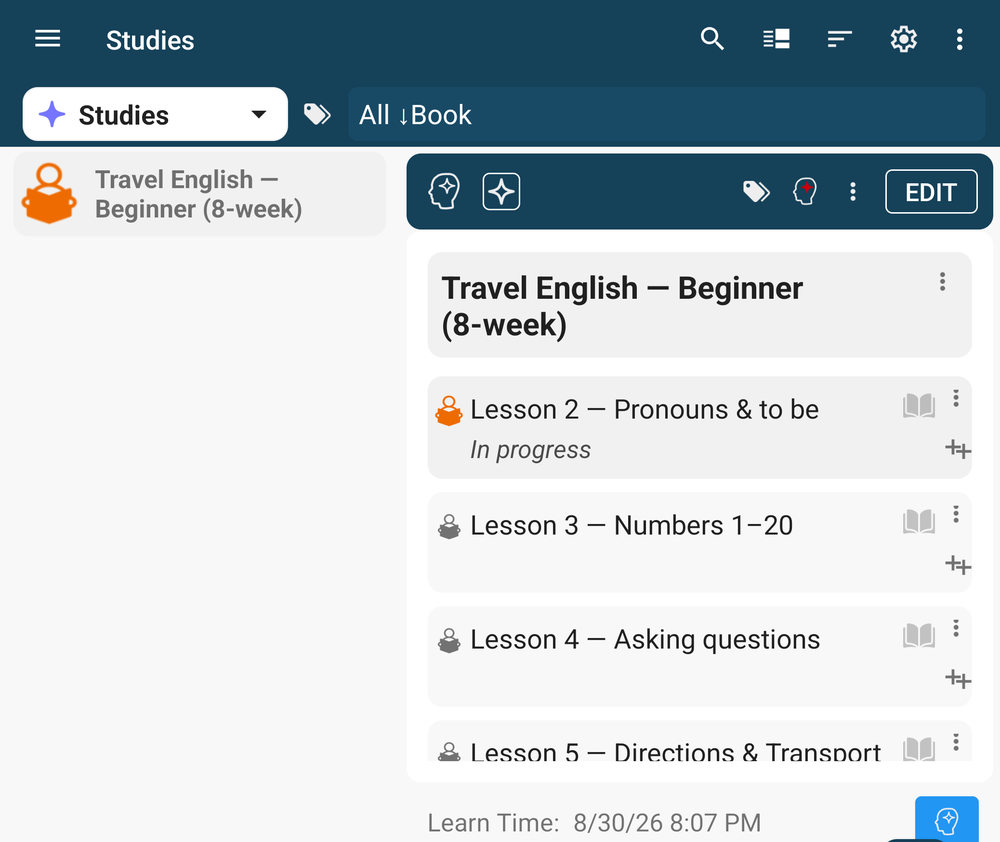
Each lesson can produce its own material:
- Create lesson book: the text to read
- Create exercise book: exercises on it
- Run quiz: a check that it stuck
- Create Flashcard: the vocabulary or structures, ready for review
Each lesson has a status (Not started, In progress, Completed), and the Studies screen shows the whole course at a glance. With a deadline, that tells you quickly whether you are on pace.
Vocabulary handling. Some exams publish word lists (Goethe, up to B1). Most publish topic lists or none. Take the topics from the official sample papers, and add 10–15 exam words a day to your daily reviews (the Exercise card on Home) from week 1 to week 10. Spaced repetition, which brings each card back when you're likely to start forgetting it, spreads them across the ninety days. Each button shows its interval; rate yourself strictly, because a card you bluff now is a word you won't have on the day.
Writing. Write the required formats (the email, the essay, the report) and give them to the AI Mentor for feedback, with the exam's published criteria pasted in. Ask what a marker would take marks off for. Then write it again. The feedback is a study aid, not an official mark. Do this every week.
Listening. Weak listening is often a speed problem. Use audio with its transcript, at full speed, several times. Add real speakers: a film or series with its subtitles, or an audiobook with its book, replaying the same scene.
Weeks 9–11: The speaking section
Do not walk into the oral exam without having spoken under pressure.
Run Speaking practice sessions three times a week. Ask for role-play scenarios matching the exam format — describe a picture, argue a position, discuss a topic with a partner.
Spoken review sessions also change your review dates: words you get wrong come back sooner. (Text Practice sessions don't change your review dates.)
Then use pronunciation feedback for the phrases you keep getting wrong. You get what you were asked to say, what was heard, your phrase corrected, and how it should sound. Compare the first week's attempts with the third.
The skill you are training is speaking clearly while nervous, and only speaking trains it.
Weeks 12–13: Format, not content
Stop adding new material. New words now cost review time you need for timed practice tests; spend the time on the format.
- Full practice tests, timed, weekly. No exceptions on timing.
- Review mistakes properly. For each error, decide: didn't know it, knew it but misread, or ran out of time. Three different problems, three different fixes.
- Keep reviews running. Five to ten minutes a day of reviews keeps what you have learned fresh.
- Learn the instructions. Knowing each task type means you don't spend three minutes on exam day working out what is being asked.
Keep the last week light, and don't cram the night before.
What to expect
Ninety days at an hour a day suits someone who is already close to the pass mark. If your baseline is far below it, consider a later exam sitting and a longer plan. Better to know that in week one than in week eleven.
If you keep only one habit, make it weekly timed writing with feedback.
Take the practice test first. Then build the plan around what it tells you.
Flashcards and daily reviews are free; the AI Mentor course, lesson books, writing feedback, Speaking practice and pronunciation feedback use AI, which is part of pimReader Plus. When you open an AI feature, pimReader offers Try free for a month: no card, no account, nothing renews. Tap Not now to carry on without AI.