

How to Learn a Language by Reading
Reading in the language you are learning is the largest amount of real input you can get in a day. What stops most people is the cost of every lookup. pimReader is built to make a lookup cost nothing, and to turn the words you look up into a review schedule that brings them back.
Reading is the cheapest way to meet a language at volume. A novel gives you tens of thousands of words in context, in an order that holds your attention, for free. Nothing else — not a course, not an app of drills — comes close on sheer input.
The reason most learners don't read is not the reading. It's the interruptions. Every unknown word means leaving the page, finding a dictionary, finding your place again. Twenty times a page, and you stop.
Everything below is about removing that cost, and then making each lookup count for something later.
Read what you would read anyway
Start with material you would choose in your own language: a novel you already like in translation, the news you follow, a blog on your work. pimReader reads EPUB, PDF, TXT, HTML and Markdown, and pulls articles from RSS and Atom feeds.
Pick by interest, not by level. Interest is what carries you through the slow first chapters; a "graded reader" you don't care about will be abandoned by page ten. If the material is too hard, the vocabulary tools below will tell you — see Know where you stand.
Unknown words are translated above the line
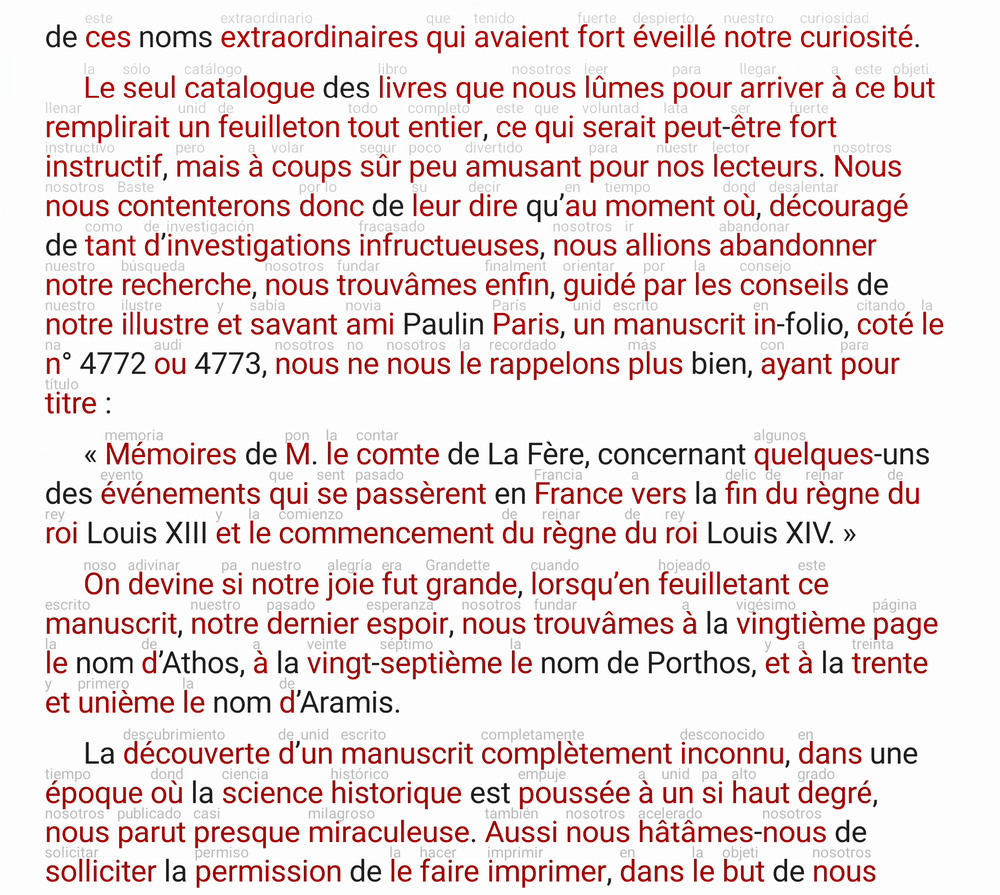
Open the book and read. Words you don't know carry a small translation printed directly above them, in the line. You keep reading; the meaning arrives as you need it.
When a gloss is not enough, tap the word. The dictionary entry opens where you are — the full entry, with the page still underneath it — and closes back to the same place. Select a whole phrase and every word in it is translated together, so an idiom reads as one thing rather than as its parts.
When the problem is the whole sentence rather than one word, tap Show Translation: the panel beside the page shows a translation of the passage you are on, and switches back to the dictionary with one tap.
The guideline: do not look up everything. Look a word up when you have met it three times, or when the sentence collapses without it. Tolerating a little ambiguity is a skill you are deliberately training, and it is what lets you read at speed.
Know where you stand
pimReader tracks which words you know. Mark a word as known and it stops being glossed. Over a few weeks that leaves a clear picture: glossed words are the ones you still need, and everything else is yours.
It also estimates your vocabulary size against a frequency list. That number answers a question learners usually guess at: is this material right for me? If more than one word in ten on a page is glossed, the text is too hard for pleasure reading — keep it for study sessions and read something easier for volume.
Keep the words worth keeping
When a word is worth remembering, tick Memorize. The card is written for you, from the sentence you found the word in, and filed under the book. That is the whole authoring step; it costs a moment.
Then the schedule takes over. pimReader uses FSRS, a spaced-repetition algorithm that models how quickly you forget each word and brings it back just before you would. Each review offers four ratings — Again, Hard, Good, Easy — and each button shows the interval it will set, so you can see the consequence before you choose.
Be selective. Adding every unknown word is the classic beginner mistake and produces a review queue you will come to dread. Add a word if it is frequent, or if you keep meeting it. Five to ten words from a reading session is plenty. You will meet the rest again if they matter.
Use the words in sentences
Recognising a word on the page is not the same as being able to use it. Open Practice and pick a mode:
- Develop Fluency — example sentences at your level, built from your own words
- Memorize Words — short phrases made to make a word stick
- Practice Dialogs — a conversation, line by line, that you take part in
The sentences are generated from the words you are learning and at a level you set, so the vocabulary from Tuesday's chapter turns up in sentences you might actually say. Ten minutes of this after a reading session converts passive recognition into words you can produce.
Say them out loud
Reading builds recognition; speaking is its own skill and only improves by speaking. Speaking practice runs an entirely spoken session: it asks, you answer aloud, and what you get right or wrong goes back into the same review schedule. For the words you keep mispronouncing, pronunciation feedback shows what you were asked to say, what was heard, and your phrase corrected.
Start this in the first week, when you know forty words. It will be short and uncomfortable. Learners who wait until they "know enough" to speak wait forever.
A routine that holds
- Read 20–30 minutes a day. Real material, glossed. Look up little.
- Add 5–10 words from what you read. Not more.
- Review 2–3 minutes a day. FSRS keeps it that small.
- Practise or speak 10 minutes, twice a week, using the words you added.
That is under four hours a week, and the reading part is the part you would have wanted to do anyway. After three months you will have around a thousand words in your review queue, all of them met in context, and a reading speed that has roughly doubled since the first chapter.
Open something you want to read in the language, and read the first page with the glosses on. That is the whole start.