

Staying Current in Your Field Without Drowning
June 30, 20264 min read
Follow a fast-moving field without reading everything: collect many feeds, sort them by a topic, triage in three tiers, and keep a few key facts as flashcards.
Skip to the guideIn most fields more is published each week than you could read in a month, and much of it is noise.
Reading everything means reading nothing carefully. Reading nothing means hearing about important changes late, from a colleague.
This guide takes a middle path: collect broadly, select hard, and keep very little.
Step 1: Collect broadly
Start by adding sources, more than you can read. That is on purpose.
pimReader takes RSS and Atom feeds, OPDS catalogues, Telegram channels and X accounts. The built-in feed directory is a quick way to find the obvious sources in your field. For sites that don't publish a feed, you can save individual pages.
Already follow sources in another reader? Bring your list with Feeds → ⋮ → Import feeds (OPML).
Aim for thirty to sixty sources across three categories:
- Primary: where things are announced
- Analysis: people who explain what the announcements mean
- Adjacent: one field over, where new ideas come from
Don't keep the list small to make it manageable. Selection is the next step's job, and a narrow list means you miss things.
Articles are cleaned down to their text when you open them, so a badly formatted source is still readable.
Step 2: Let selection do the work
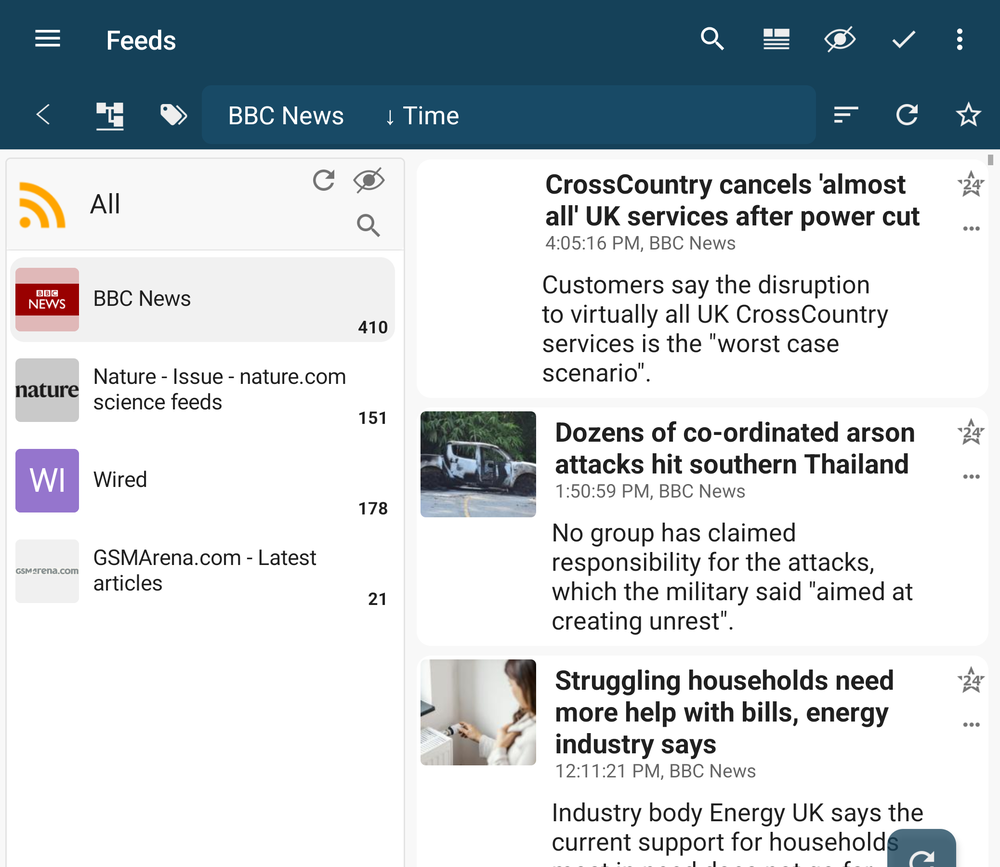
This step makes a large feed manageable.
Sort by relevance to a topic. Instead of reading in date order, type the topic you care about today and pimReader orders the articles by how close they are in meaning, not just by keywords. Sort by "retrieval-augmented generation" and the closest articles come first. Date order treats every item as equally important; topic order does not.
Recommendations. After some reading history, pimReader can build a recommendation list from what you read. It needs time before it is useful.
Use categories. Many sources publish their own categories, and the app picks them up. Filtering by category is rough, but fast.
The goal is to go from hundreds of items to about fifteen worth opening. Mark the rest read. You don't have to read something just because you subscribed.
Step 3: Triage in three tiers
For the fifteen that survive:
Skim. Most items. Read the summary, understand what happened, move on. Ask for a summary if the article hides its point.
Read. Three or four a week that really matter. Read them properly, offline if you are commuting: saved articles work without a connection, and the reading view removes the clutter around the text.
Study. Maybe one a week. Something that changes how you think, or that you'll need to know.
Only that last tier gets any further effort. Keep it small.
Step 4: Keep the handful worth keeping
This turns a news habit into knowledge you keep.
For the study-tier articles, save what matters as a note, then turn it into a flashcard or two. Not a summary of the article, but the specific fact or difference you would want to know in a meeting six months from now.
Good ones look like:
- "What's the practical difference between the two approaches announced this quarter?"
- "What throughput figure did the benchmark report, and under what conditions?"
The cards join your daily reviews (the Exercise card on Home), timed by spaced repetition, which brings each card back when you're likely to start forgetting it. Two or three cards a week make a short daily review and, over a year, a record of how your field moved.
Step 5: Ask your own archive
After a few months your library is a searchable record of what you have read.
"What have I read about model-serving costs in the last six months?"
Search by meaning works across your saved articles, books and notes, even when the text uses different words. This is the payoff for collecting broadly: you can find the article you half-remember.
The AI Mentor can work with this material too: summarise a topic across several sources, or point out where two sources disagree.
A weekly rhythm
Daily, 10 minutes. Skim the top of the relevance-sorted list. Mark the rest read.
Twice a week, 30 minutes. Read the two or three that matter properly.
Weekly, 15 minutes. Take the one study-tier article, capture the notes, make the cards.
Daily, 1–2 minutes. Daily reviews.
That is under three hours a week.
Give up on reading everything. Once you do, the job becomes choosing well.
Feeds, saved articles, notes, flashcards and daily reviews are free; sorting by topic, recommendations, summaries, search by meaning and the AI Mentor use AI, which is part of pimReader Plus. When you open an AI feature, pimReader offers Try free for a month: no card, no account, nothing renews. Tap Not now to carry on without AI.