

Soft Skills Can Be Trained: Anna Learns to Give Feedback
Imagine a new team lead who knows the theory of good feedback and still gets it wrong when it counts. Follow Anna through one week with pimReader: a course built around her situation, honest coaching on her own words, flashcards that keep the ideas fresh, and a rehearsal of the conversation she has been avoiding.
Imagine Anna. She has just been promoted to team lead. She is good at her job, people like her, and she has read a couple of books about management.
On Tuesday, a developer on her team delivers a feature two days late, without warning anyone. Anna knows she has to say something. She has read about feedback: be specific, talk about behaviour, suggest a next step. But in the moment, what she says is: "You need to be more proactive."
He nods. She nods. Nothing changes.
Most people who have ever led a team, a project or even a group assignment will recognise this. Knowing what good feedback looks like is one thing. Saying it calmly, in the right words, to a real person, is another. That second part only comes with practice, and practice is exactly what most of us never get.
Soft skills work much like a language. You get better with short, regular practice, honest correction, another try, and a reminder a few days later before the idea fades. Let's follow Anna through one week and see what that can look like in pimReader.
Day 1. Anna says what she wants to learn
In the evening, Anna opens Ask AI, taps the Help me to learn ... tile and finishes the sentence:
Help me to learn giving constructive feedback to colleagues. I am a new team lead. Please create a study with 4 short lessons and practice dialogs.
She doesn't have to search a catalogue or compare courses. She describes the skill in her own words.
Before planning anything, the Mentor asks her a few questions.
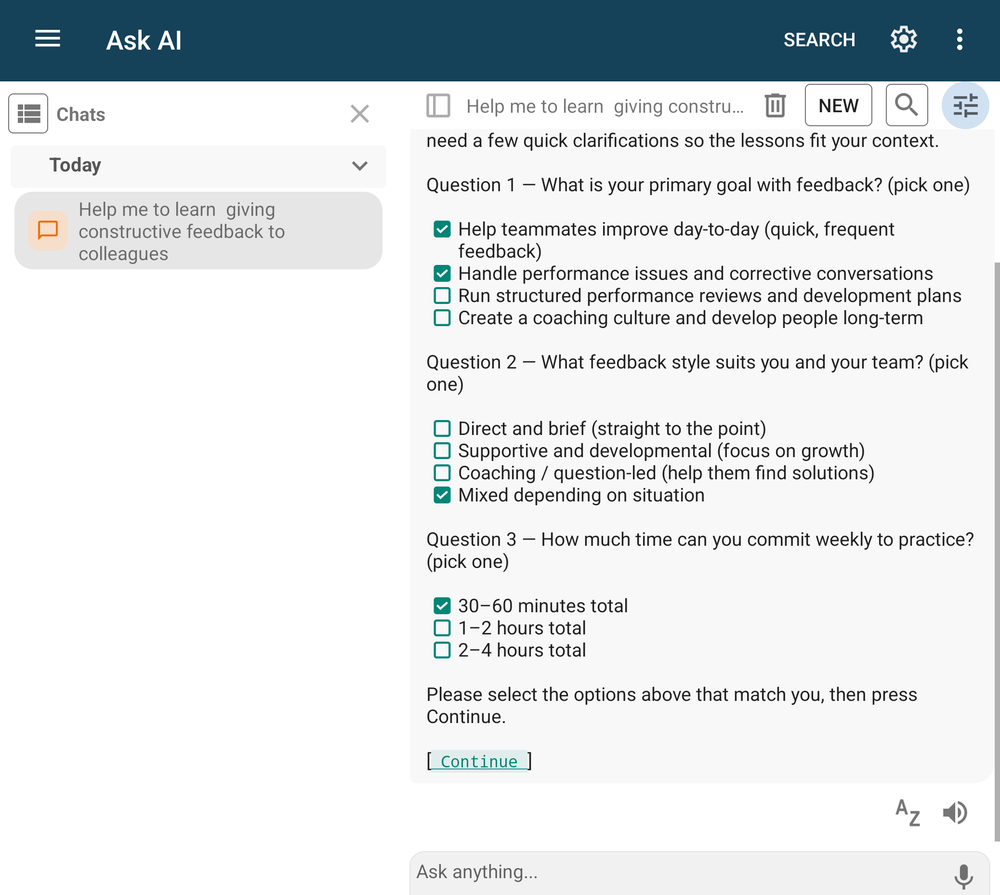
What does she want to improve most: everyday feedback, difficult corrective conversations, formal reviews, or a coaching culture in the team? Which style fits her team: direct, supportive, question-led, or a mix? How much time can she realistically give each week? How much feedback has she given before?
Anna ticks day-to-day feedback, performance issues and corrective conversations, mixed depending on situation and 30–60 minutes a week.
These answers matter. A plan for a new team lead with half an hour a week should look very different from one for an HR manager preparing annual reviews. The more honest the answers, the more useful the course.
The plan: four short lessons
A minute later Anna sees the plan: four short lessons, each with a brief description she can open.
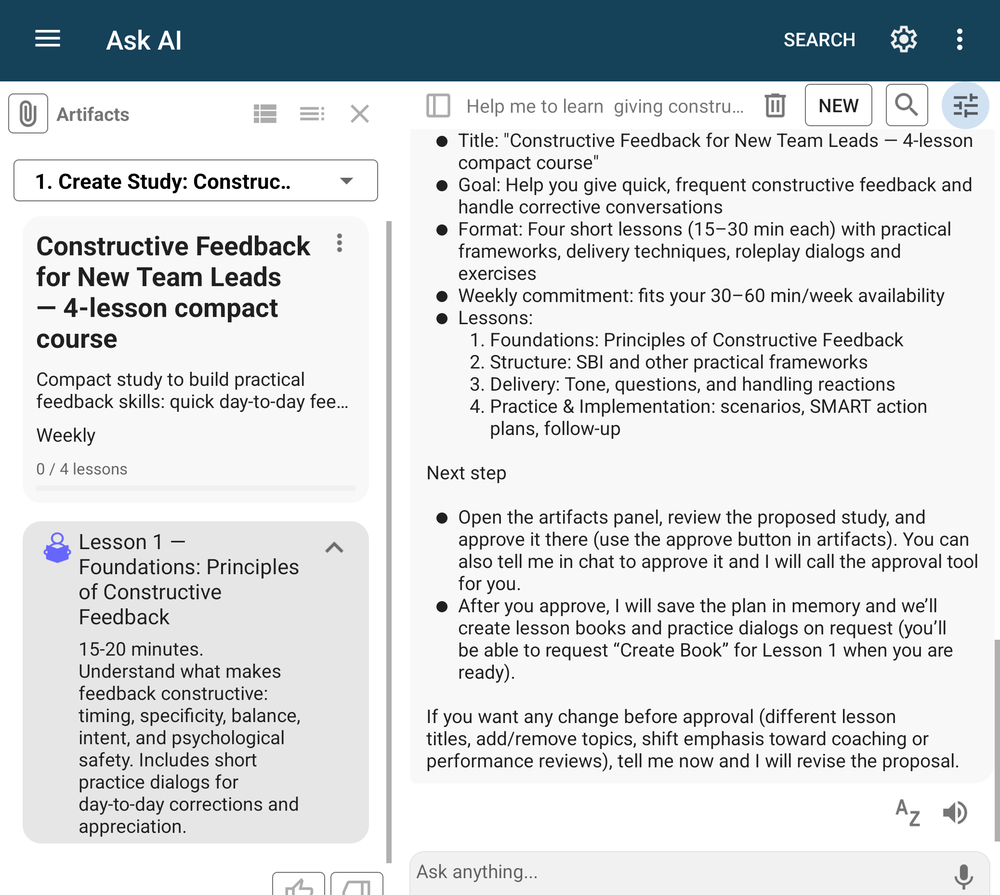
- Foundations — what makes feedback constructive
- Structure — the SBI model and other simple frameworks
- Delivery — tone, good questions and handling emotional reactions
- Practice — real scenarios, action plans and follow-up
Fifteen to thirty minutes per lesson, once a week, which fits the time she said she has.
Seeing the whole plan in advance helps. Many people give up on self-development because they don't know where it is going or how long it will take. Here Anna knows both. If something didn't fit, she could ask for changes. It looks right, so she approves it, and the course appears in her Studies.
One step at a time
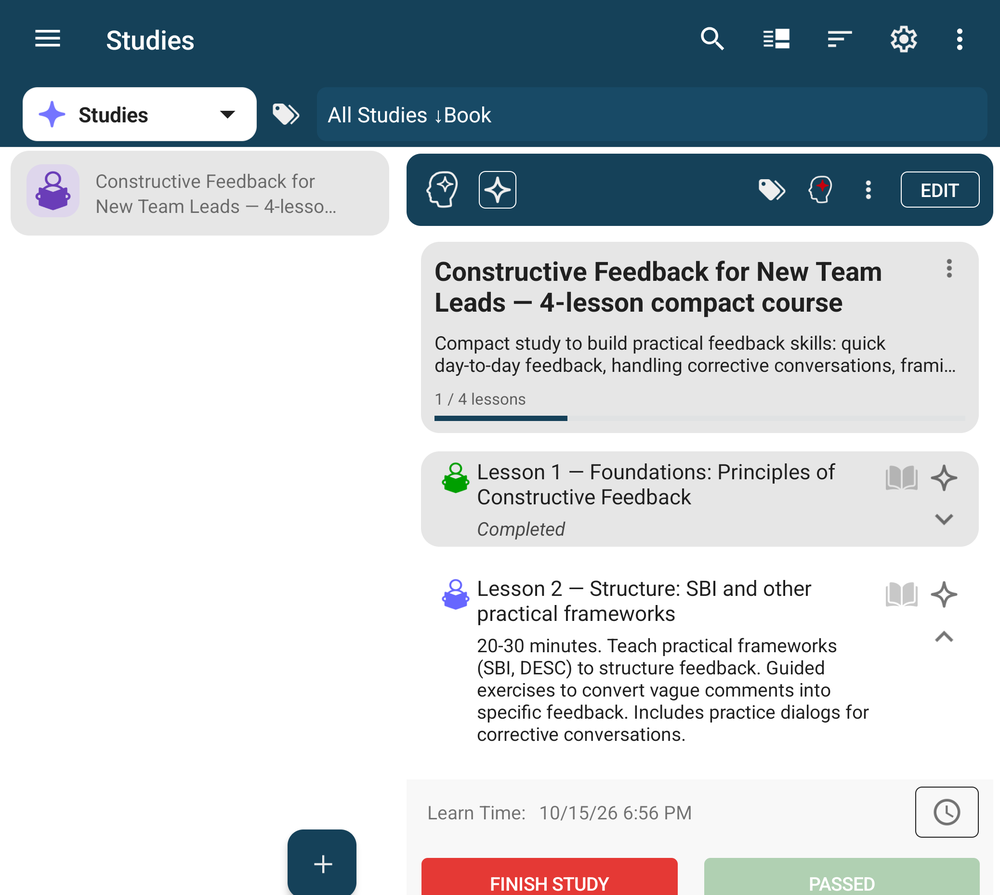
Each lesson has its own menu: start it, read it, practise, take a quiz, create flashcards. When Anna finishes a lesson, she marks it complete and the next one becomes current.
The app doesn't tick a lesson off just because she opened the book or passed the quiz. Anna decides when it is done, ideally after she has tried the skill with a real colleague. It is a small thing, but it keeps the progress line honest.
Day 2. A lesson book written for her
Anna taps Create lesson book, and the Mentor writes a 23-page book for lesson 1, written for a new team lead who wants to give quick everyday feedback and handle a few difficult conversations.
Inside she finds:
- why feedback should be about behaviour, never about personality;
- the simple chain of observation → impact → next step;
- when to give feedback: soon, and in private;
- why people need to feel safe before they can really listen;
- a two-minute routine to prepare for any feedback conversation;
- ready-made phrases she can use the next day.
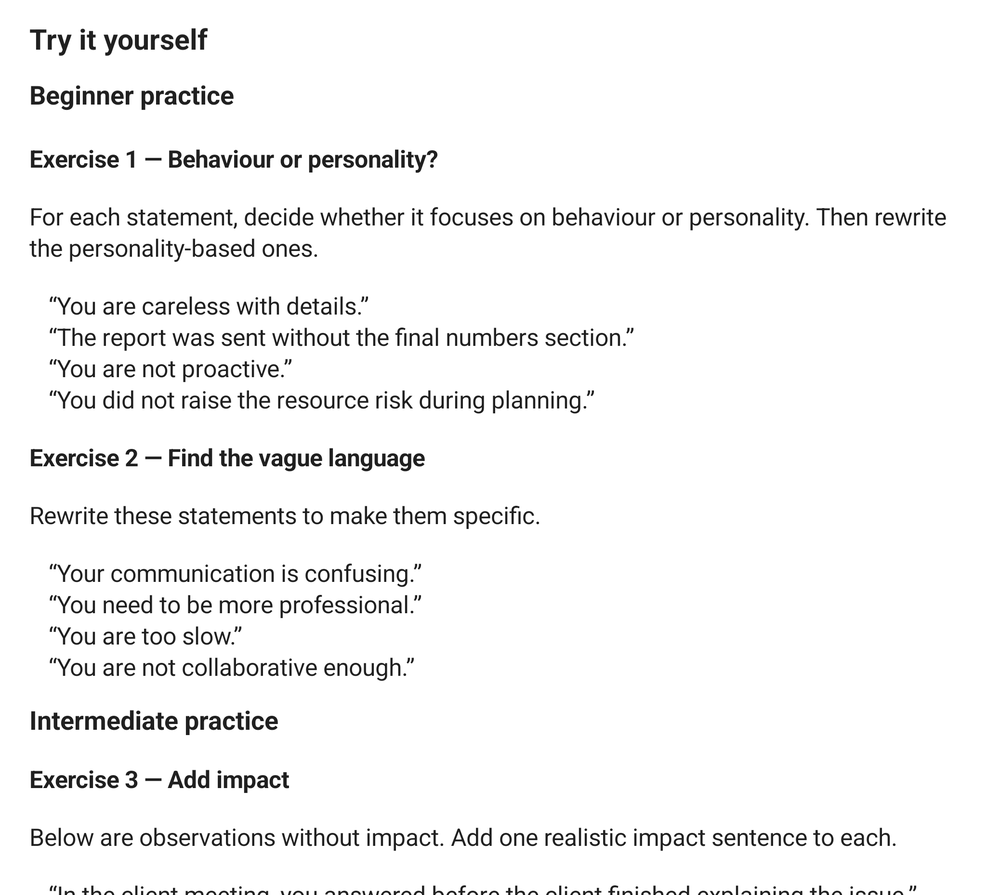
At the end come exercises. Is "You are careless with details" about behaviour or personality? Rewrite it. Make "You need to be more professional" specific. They start easy and get harder. The answers to the final check stay hidden until she has written her own.
One of the sentences looks very much like her own "be more proactive". Anna smiles a little.
The book stays in her library like any other book. She can bookmark useful phrases, add notes, and reread a page before an important meeting.
Day 3. Practice, where mistakes are safe
This is the most important part.
Anna taps Practice. The Mentor asks her to write a piece of feedback she might give this week. She writes it the way people often do when they are tired and annoyed:
You were unprofessional in the demo yesterday and it made the whole team look bad. Please be more careful next time.
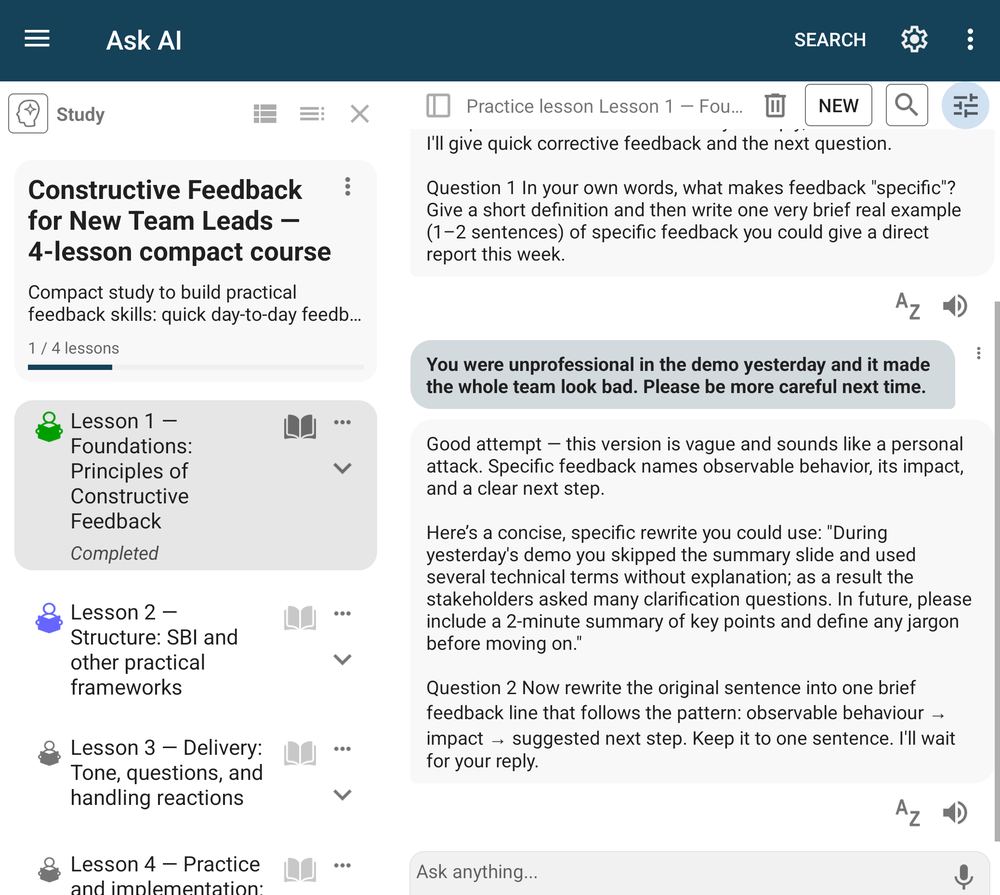
The answer is polite and direct: "this version is vague and sounds like a personal attack. Specific feedback names observable behavior, its impact, and a clear next step."
Then it shows what that could sound like: "During yesterday's demo you skipped the summary slide and used several technical terms without explanation; as a result the stakeholders asked many clarification questions. In future, please include a 2-minute summary…"
And then it asks Anna to rewrite her own sentence.
In real life nobody stops the conversation to explain why your words didn't work. You see the reaction and have to guess. Here Anna can try ten versions in ten minutes, and nobody gets hurt.
A tip if you try this yourself: write what you would actually say, not the textbook answer. The closer it is to your real habits, the more you will learn.
Day 4. A short quiz
At the end of the lesson Anna takes a short quiz: five questions, some multiple choice and some where she writes her own answer. One asks her to rewrite the sentence she practised the day before.
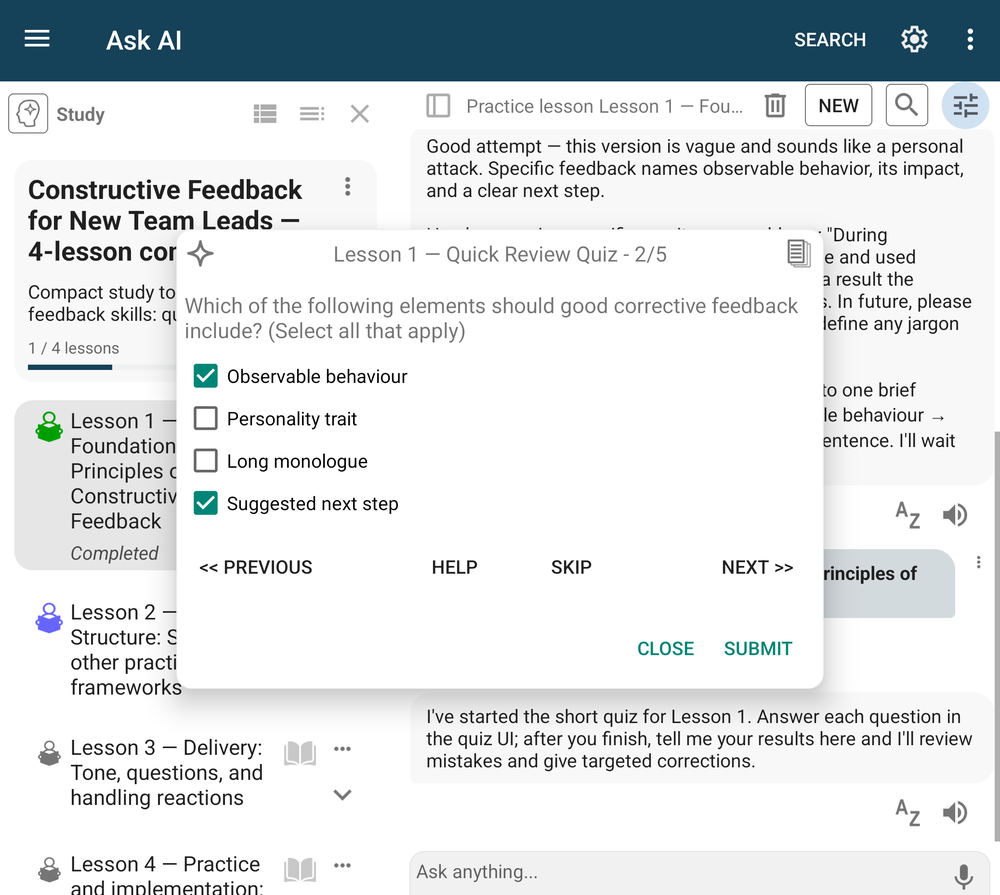
The wrong answers are believable. Personality trait sits next to Observable behaviour, and "immediately, in front of the team" next to "soon, in private and calm". She has to think.
After she submits, the Mentor goes through every answer, explains what was nearly right and suggests what to do next: practise a bit more or move on to lesson 2.
Flashcards, so it isn't forgotten
People forget most of a training within days. That is why workshops often change so little.
So Anna turns the key ideas into flashcards. The Mentor suggests six, and she can remove any before saving.
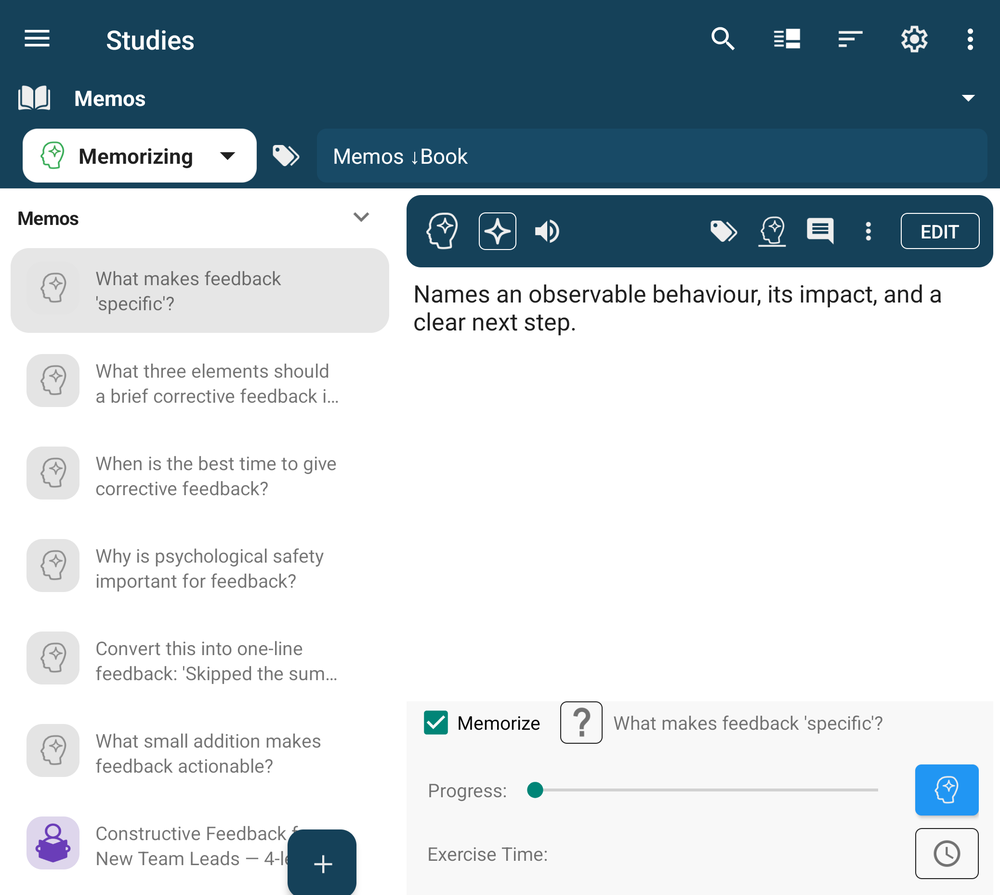
The cards go to Studies → Memorizing, and pimReader's spaced-repetition engine brings each one back shortly before she would forget it. It is the same method language learners use to remember thousands of words.
A week later, "What makes feedback 'specific'?" appears in her review queue. It takes twenty seconds. That afternoon, in a one-on-one, she describes what happened instead of judging the person.
Day 5. Rehearsing the difficult conversation
Anna has one conversation she keeps putting off. Last week she rejected a senior engineer's pull request in front of the whole team, and he was clearly hurt.
She decides to rehearse it first. In a new chat she writes:
Role-play: you are Mark, a senior engineer who is upset because I rejected his pull request in front of the team. I am his new team lead and want to practise de-escalating this 1:1. Coach me briefly after each of my replies.
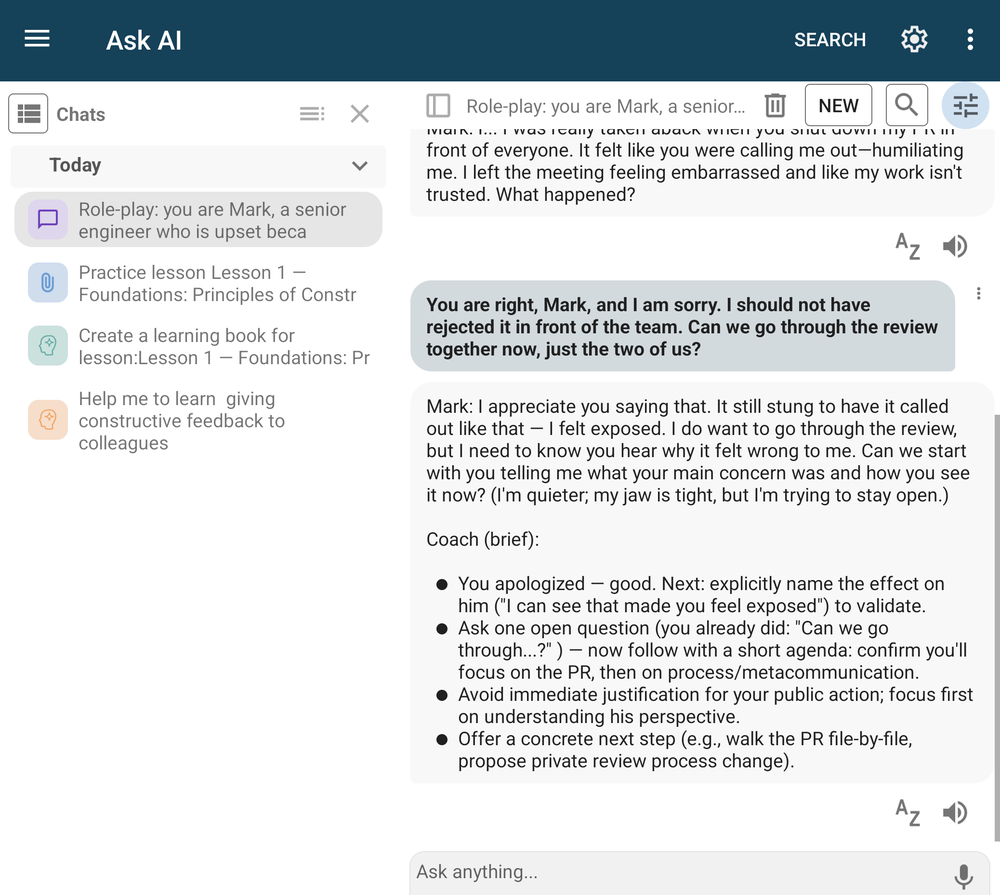
First the Mentor asks how strongly Mark should react: furious, upset, or calm but disappointed. Anna chooses upset. Mark begins:
"I was really taken aback when you shut down my PR in front of everyone. It felt like you were calling me out."
Even in a simulation, it's uncomfortable to read, and that is why the rehearsal is useful.
Anna apologises and offers to go through the review together, just the two of them. Mark stays in character: "I appreciate you saying that. It still stung to have it called out like that — I felt exposed." Below his reply comes a short coaching note: acknowledge how he felt ("I can see that made you feel exposed"), suggest a short plan for the conversation, don't defend the public rejection yet, and offer a concrete next step, such as going through the PR together file by file.
When Anna has the real conversation, she has already said the difficult words once. It is still not easy, but it goes much better than it would have.
Not only feedback
Anna's story is about feedback, but the same approach works for most soft skills:
- Public speaking — rehearse a talk and answer questions from a demanding audience.
- Negotiation — practise asking for a raise from a manager who says "the budget is tight".
- Active listening — talk to a frustrated customer and find out what the complaint is really about.
- Saying no — practise turning down extra work politely and firmly.
- Running meetings — learn to bring a drifting discussion back to the point.
- Resolving conflict — rehearse a tense conversation with a colleague, a friend or a neighbour.
It starts the same way: "Help me to learn...", a few honest answers, and fifteen minutes a week.
If you're not sure where to begin, pick the skill that let you down most recently: the conversation that went worse than it should have. That is usually the one worth practising first.
Two practical notes
Learning in your own language. The Mentor answers in the native language set in pimReader. To get lessons, quizzes and flashcards in your language, set it as your native language and tell the Mentor once, in its behaviour settings, to always answer in that language. If you'd rather not see words highlighted while reading the lesson book, turn off Highlight unknown words in the reader settings.
Marking progress. A lesson is complete when you mark it. The most useful moment to do that is after you have tried the skill with a real person, not just after reading about it.